

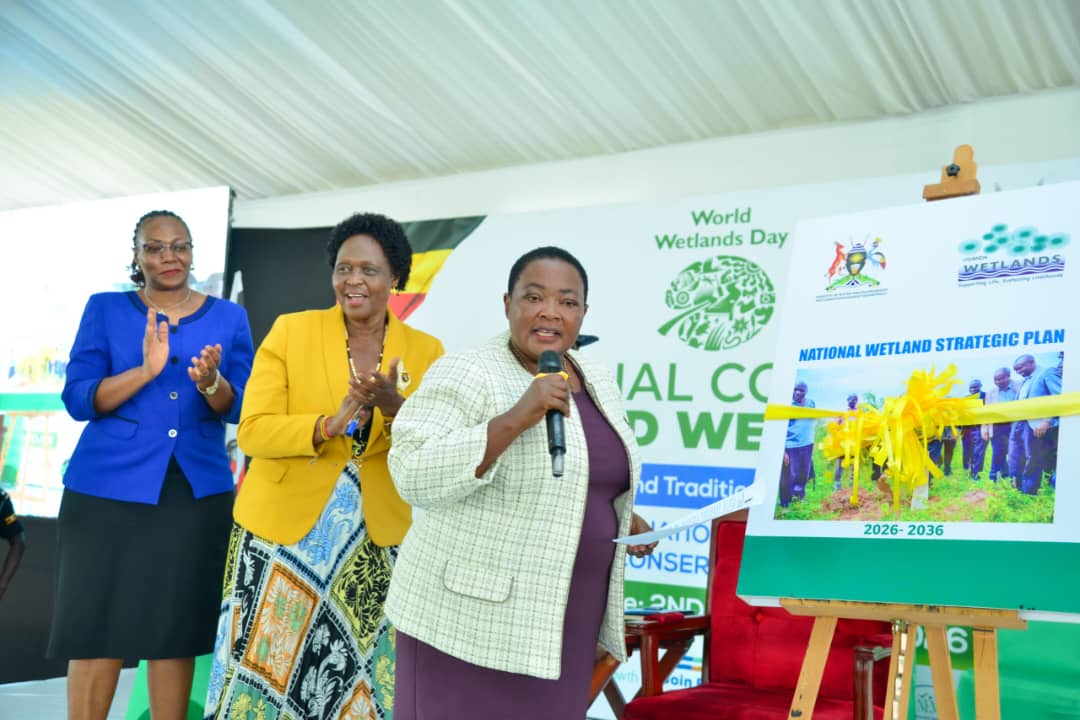
Uganda has launched the National Wetland Strategic Plan 2026–2036, reaffirming the government’s commitment to conserving wetlands as critical ecosystems amid growing pressures from encroachment, degradation, and climate change.
The plan was officially launched in Kampala during World Wetlands Day celebrations, officiated by Prime Minister Robinah Nabbanja, representing President Yoweri Kaguta Museveni.
Speaking on behalf of the President, Nabbanja emphasized that wetlands support rain formation, water purification, biodiversity conservation, and livelihoods in agriculture, fisheries, tourism, and hydropower generation.
Highlighting this year’s theme, “Wetlands and Traditional Knowledge: Celebrating Cultural Heritage,” the Prime Minister noted that Ugandan communities historically protected wetlands through cultural norms, taboos, and sustainable practices.
“Long before modern environmental laws, our ancestors practiced the principle of wise use,” she said, urging preservation of indigenous knowledge such as seasonal access, fish breeding protection, and sustainable papyrus use.
Nabbanja cautioned that modernization should not erase these conservation values, encouraging communities near wetlands to adopt sustainable activities like fish farming along wetland peripheries. She also underscored government’s commitment to wetland conservation through restoration programs, enforcement, community engagement, and strategic planning.
Minister of State for Environment Beatrice Atim Anywar said environmental conservation has been mainstreamed across national development frameworks, including Vision 2040.
She cited interventions such as the 2011 establishment of the Environmental Protection Police Unit, the 2014 cancellation of illegal wetland land titles, and ongoing wetland restoration and boundary demarcation efforts.
Anywar also announced a 10-year Environment and Natural Resources Restoration Action Plan aligned with the UN Decade on Ecosystem Restoration to accelerate nationwide wetland recovery.
She stressed the role of community stewardship and traditional knowledge, noting collaboration with cultural leaders and local institutions to integrate indigenous practices with modern science.
Both leaders commended development partners, including UN agencies, civil society, and local communities, for their support in wetland conservation and called for stronger partnerships to safeguard wetlands as ecological, economic, and cultural heritage assets.
